How to Test a Bookkeeping Provider on a Closed Month
Bookkeeper.chat ·

To test a bookkeeping provider, give it the source documents for a month your firm has already closed and signed, keep your own books for that month to yourself, and compare its result with yours account by account. Then score what matched, what it held back, what differed, how many entries your senior had to correct and how many minutes the review took.
A hiring quiz can’t show you that. The American Institute of Professional Bookkeepers (AIPB) offers a free hiring test with 10 questions on journal entries, corrections, accruals, deferrals and the bank reconciliation. It screens a person’s knowledge and says nothing about how a provider handles your clients’ real months. References have the same limit. A closed month is the one test where you already know the right answer.
Pick the month and the clients
Pick a month your senior has already signed off, so your books are final, and make it recent enough that your team still remembers what came up. Skip year-end: it carries work most months don’t, and our year-end checklist for firms covers that side separately.
Use one to three clients your team knows well:
- one simple client, with bank, card and payment-processor activity and a straightforward balance sheet;
- one with the problem you see most often, such as missing receipts, owner spending mixed into the business account or payouts that need splitting;
- optionally one on your other ledger, if your firm works in both QuickBooks Online and Xero.
Every candidate gets the same clients and the same month. Before you send anything, write down what your team found hard that month: the documents you chased, the entries your senior changed, the questions you sent the client. You will compare against those notes later.
What to send, and what to keep back
| Send | Keep back |
|---|---|
| Bank and card statements for the month | Your closed books for the test month |
| Payment-processor reports, such as Stripe payouts | Your reconciliations and adjusting entries |
| The books through the prior month, or the opening balances | The answers your client gave you that month |
| The client’s chart of accounts and the standing rules your firm applies to that client | Your senior’s review notes |
The right column holds the answers. A provider that sees any of it can copy the result, and the test stops measuring anything.
These are real client records, so settle confidentiality before you send them. Under the AICPA Code’s interpretation on disclosing information to a third-party service provider (1.700.040), as the Journal of Accountancy summarized it, a member should either have a contract that keeps the information confidential and gives reasonable assurance the provider can prevent unauthorized release, or get the client’s specific consent first. Leave tax returns out of the packet: tax return information has its own consent rules under Section 7216 of the Internal Revenue Code.
Play the client
In live work the provider will email your client. During the test, send those questions to someone at your firm who answers only with what the client actually told you at the time, taken from your emails and notes. If the client never answered a question, leave it unanswered in the test too. The provider then faces the same gaps your team did.
Keep every question it sends. They show whether the provider read the books before asking, and whether your client would be comfortable receiving them.
Score the result
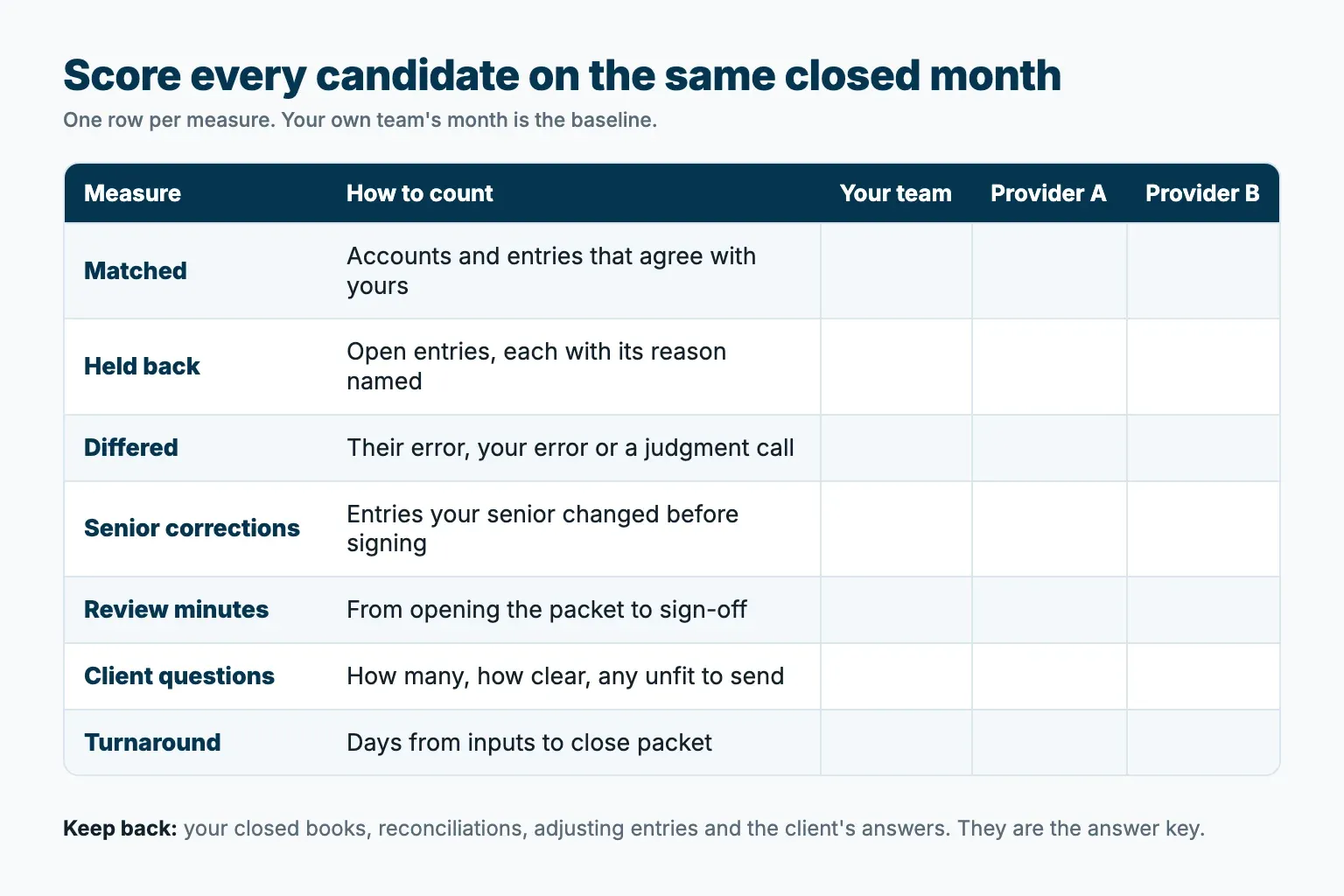
Score each candidate on the same sheet, and score your own team’s work on that month as the baseline.
| Measure | How to count | What it tells you |
|---|---|---|
| Matched | Accounts whose month-end balance agrees with your books, and entries that match yours | Accuracy on routine work |
| Held back, with a reason | Entries left open, each naming the missing document or question | Whether it asks or guesses |
| Differed, with a reason | Entries that differ from yours, sorted into their error, your error or a judgment call | Real errors versus defensible choices |
| Senior corrections | Entries your senior changed before signing | Work that comes back to your firm |
| Senior review time | Minutes from opening the packet to sign-off | The cost an hourly rate leaves out |
| Client questions | How many were sent, how many a client could answer in one reply, any that should never reach a client | How your clients will experience the provider |
| Turnaround | Days from sending the inputs to receiving the close packet | Whether it fits your close calendar |
Read the result against your own baseline
Senior review time and senior corrections decide the economics. When a provider’s packet takes your senior as long to review as your own staff’s work, the provider changes who prepares the month but adds no capacity. Our guide to outsourced bookkeeping for CPA firms turns that review time into the cost of a client-month.
For the other measures:
- An entry held back with a specific reason is a good result. A provider that books a guess to look complete creates corrections later.
- A difference where your books turn out to be wrong counts for the provider.
- One month is a sample. If two candidates finish close, run a second client or a second month before you decide.
Software, a provider or an AI team
Run the same procedure for every model and adjust what you time:
- With software your staff runs, your staff does the month inside the tool, so time your staff as well as your senior. The test shows how much preparation the tool removes.
- With an offshore team or a white-label provider, ask for the provider’s own reviewer notes with the packet, and check under whose name the client questions would go out.
- With an AI team, check that every entry carries its evidence and an explanation.
If you are replacing Botkeeper, our page on Botkeeper alternatives groups the options by these three models. For a worked comparison of two AI close tools, including how to run them on a closed month, see Meridian vs Botkeeper Infinite.
Mistakes that make the test useless
- Letting the provider choose the client or the month, which lets it pick work it already handles well.
- Testing only your cleanest client, so the test never shows how the provider deals with missing receipts or owner spending mixed into the business account.
- Judging the demo or the sales call instead of the close packet.
Questions to ask after the test
- Why did you hold back each open entry, and what would have closed it?
- Which of our answers and rules carry into next month, and where do you record them?
- How is the price set, and what changes when a client’s volume grows?
- Can you share your security documentation?
How Bookkeeper.chat runs this test
Bookkeeper.chat offers this procedure as a free Closed-Books Test. You choose one client and a month you have already closed, and we agree what to cover, when to run it and which documents to send. The AI team rebuilds the month from the statements. You compare the result with your books account by account: what matched, what was held back and what differed, and why, plus an estimate of your senior’s review time.
You can also play the client from your own email, a demo inbox or a test environment, and watch how the AI Bookkeeper asks, follows up and uses your answers. The test is free; paid monthly work starts only under a separately agreed quote.
FAQ
Can ChatGPT do bookkeeping for a client?
It can categorize transactions and draft entries from statements you paste in. Whether it can close a client’s month is a question for this same test: give it the statements for a closed month, compare the output with your books and count the corrections. Our article on whether Claude can close a client’s month shows where a chat assistant falls short.
Sources
- Journal of Accountancy (AICPA), AICPA confidentiality rule, March 2015: interpretation 1.700.040 and Sec. 7216. Checked November 8, 2026.
- American Institute of Professional Bookkeepers, Bookkeeping Hiring Test, checked November 8, 2026.