Closing the Books for 2026: Year-End Checklist for Firms
Bookkeeper.chat ·
Updated
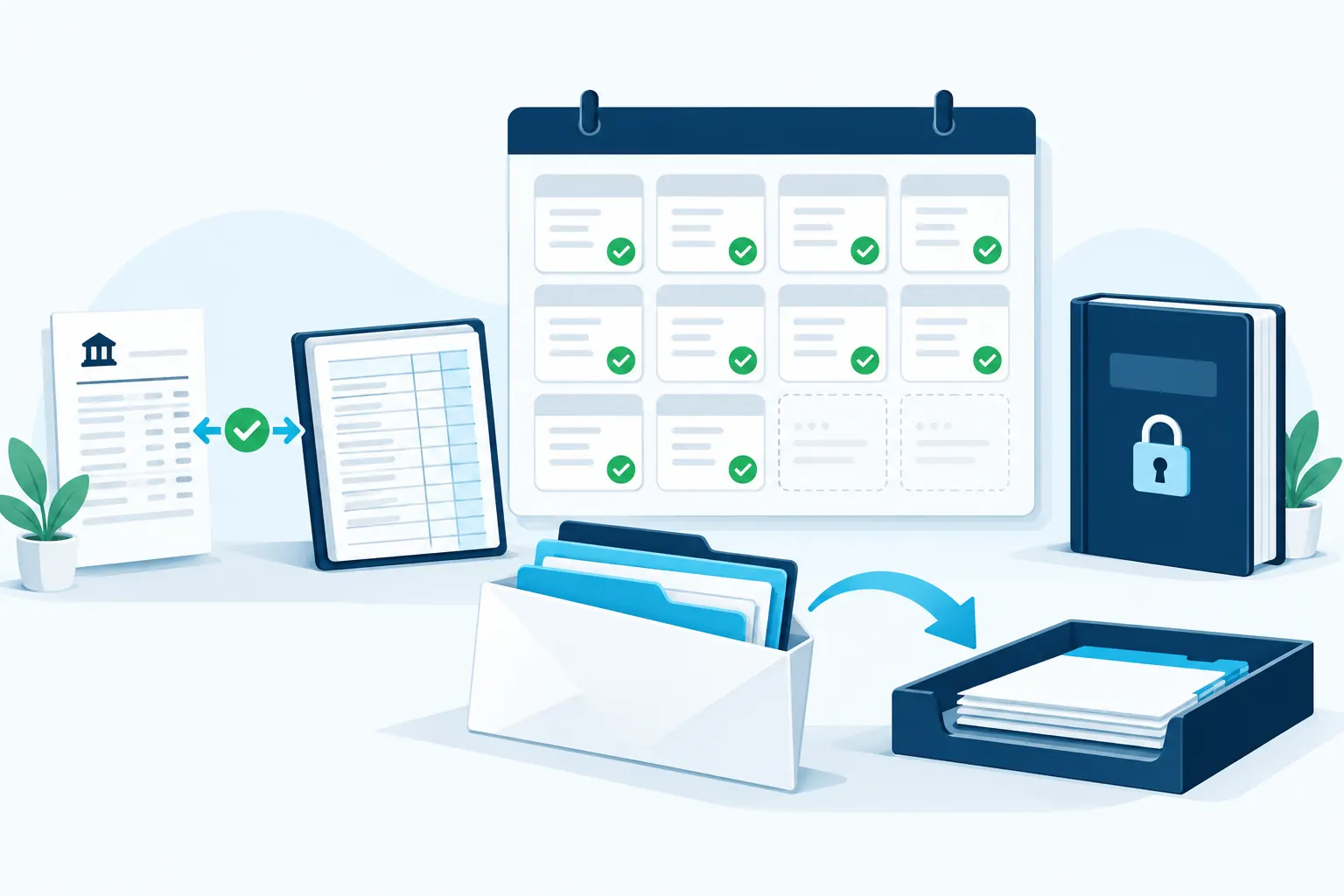
There are two months left in 2026. For a firm with monthly bookkeeping clients, that splits the client list three ways: clients current through October, clients a few months behind, and clients whose books stopped in the spring. The first group is a December job. The other two need work in November, because contractor forms are due February 1, 2027, and the returns follow.
Closing the books: the short answer
Closing the books means making sure every transaction in a period is recorded and categorized, checking the totals against the bank and card statements, and then locking the period so reported numbers can’t change by accident. Most monthly bookkeeping clients are closed every month, which keeps each reconciliation small. The year-end close adds annual work on top of the December close: contractor forms, an inventory count for clients who hold stock, year-end adjustments such as depreciation, and the package for whoever prepares the return.
A client’s month is closed when all five of these are true:
- Every bank, card, loan and payment processor account is reconciled to its statement.
- No transaction is left uncategorized or parked in a suspense account.
- Receipts or bills are attached to the expenses a reviewer may ask about.
- Open invoices and unpaid bills are up to date, if the client tracks them.
- The period is locked, so changing it takes a deliberate unlock.
Sort your clients before December
Year-end goes faster when each client is in a known state by mid-November. Sort the list once, then plan the work around the February 1 forms.
| Where the client’s books stand | What to do in November | What to watch |
|---|---|---|
| Closed through October | Start the year-end requests now and keep the monthly close on schedule | Contractors without a W-9 |
| One to three months behind | Collect the missing statements and close the open months, oldest first | Questions the client hasn’t answered |
| Not closed since the spring | Scope it as a catch-up project, agree on a cut-off date for documents and close month by month | A missing statement stops the catch-up at that month |
| No reliable starting balance | Get the December 31, 2025 balances from last year’s return or the December 2025 statements first | Every later month depends on this balance |
Month-end close checklist
Run these in order for each client.
- Collect the statements. Get the month’s statement for every business bank account, credit card, loan and payment processor, such as Stripe, PayPal, Square or Shopify Payments.
- Get every transaction in. Import or enter everything through the statement end date, including card charges that posted on the last day.
- Categorize. Give each transaction an account. Mark transfers between the client’s business accounts as transfers rather than income or expenses, record money the owner puts in or takes out as owner contributions or draws, and pull personal purchases out of business categories.
- Reconcile. Compare each account’s ending balance in the books with the statement. Items that haven’t cleared yet, such as a check the client wrote or a deposit in transit, explain part of a difference. Anything left over has to be found before the month is locked.
- Attach the evidence. Match receipts and bills to expenses, especially meals, travel, equipment and large purchases.
- Update what the client is owed and what it owes. If the client invoices customers or records bills before paying them, check both lists against the payments that came in and went out.
- Read the profit and loss. Compare it with last month. Check any category that doubled or vanished; it is often a miscategorized transaction.
- Lock the month. In most accounting software this is a closing date setting. For QuickBooks Online, Intuit’s help explains how to lock your books.
Worked example: does October tie out?
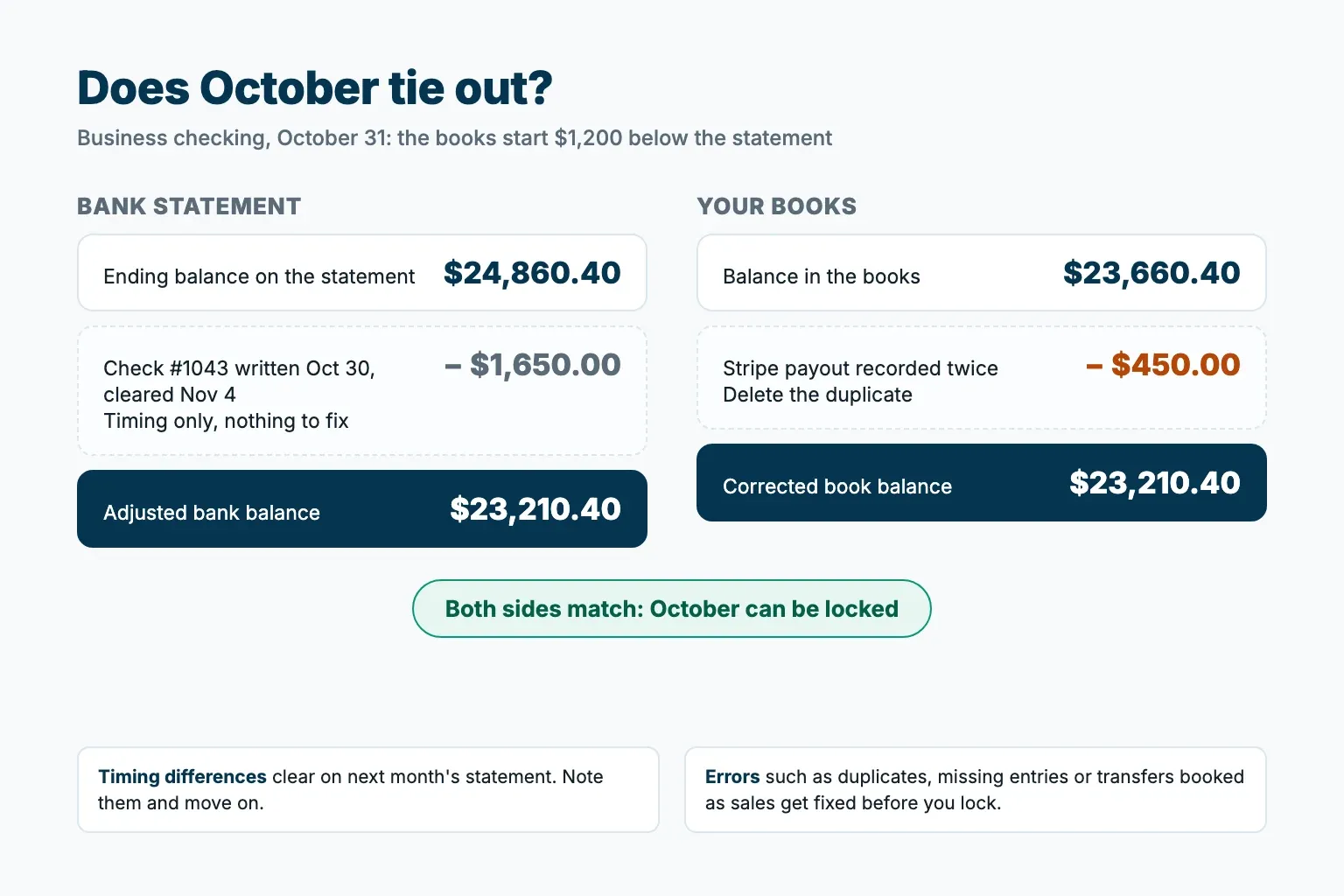
A client’s business checking statement shows an ending balance of $24,860.40 on October 31. The books show $23,660.40 for the same account, $1,200 less.
Two items explain the gap:
| Item | Effect on the books | What to do |
|---|---|---|
| Check #1043 to a contractor for $1,650, written October 30 and cleared November 4 | Books are $1,650 lower than the bank | Nothing. It’s a timing difference that clears next month |
| A $450 Stripe payout recorded twice, once from the Stripe report and once from the bank deposit | Books are $450 higher than they should be | Delete the duplicate |
After the duplicate is removed, the books show $23,210.40. The statement balance of $24,860.40 minus the $1,650 check that hasn’t cleared is also $23,210.40, so October reconciles and can be locked.
Catching up a client who is behind
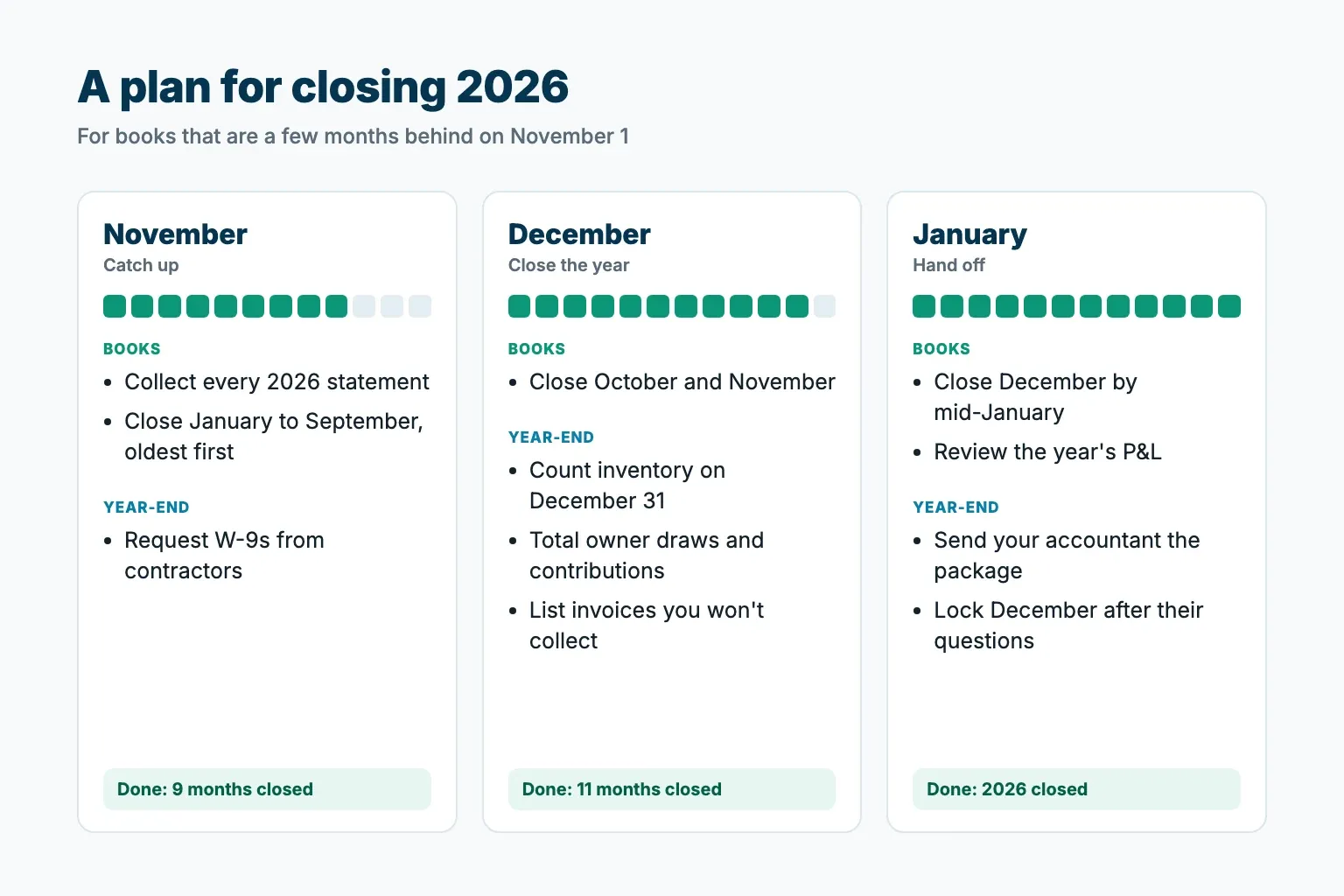
Close the missing months in order, oldest first. Each month starts from the previous month’s reconciled ending balance, so a wrong March carries into every month after it.
- Start from a known balance: the December 31, 2025 balances used for last year’s return, or the client’s December 2025 bank and card statements.
- Collect every statement before you start. A missing month stops the catch-up at that month.
- Categorize repeat vendors in batches. The same software subscription or supplier usually shows up every month.
- Keep a running list of questions for the client instead of sending them one at a time, then send them together.
- Set a date for each month and share the plan with the client, as in the example below.
If a client is moving off QuickBooks on January 1, close and reconcile 2026 there first. The Mercury Books vs QuickBooks guide covers that switch.
Closing the year: the once-a-year tasks
- Contractors: for payments made in 2026, Form 1099-NEC is generally required for each contractor a client paid at least $2,000 for services in the course of its business; for 2025 payments the threshold was $600. Payments to most corporations are exempt, but legal fees are not. Payments made by card, and certain payments through payment apps, are reported on Form 1099-K by the payment company instead.
- Contractor forms: they go to contractors and the IRS by February 1, 2027, so get a Form W-9 from each contractor now if the client doesn’t have one. If your firm e-files them directly, the IRS now accepts them only through its IRIS portal.
- Payment platforms: payment apps and marketplaces such as PayPal send Form 1099-K when a client’s payments through them for the year exceed $20,000 and the number of transactions exceeds 200. Payments received by card are reportable at any amount, and some states set lower thresholds. The form shows gross amounts before fees and refunds, so reconcile it with the platform’s year-end report and the recorded sales rather than the payouts that reached the bank.
- Employees: if the client runs payroll, employees must get Form W-2 by February 1, 2027.
- Inventory: if the client sells goods, someone counts what’s on hand at December 31.
- Unpaid invoices: list customer balances the client doesn’t expect to collect; the tax preparer decides how to treat them.
- Equipment and loans: keep the invoices for equipment bought in 2026 for the depreciation decision. Split loan payments into principal and interest using the lender’s year-end statement.
- Owner money: total what the owner took out of the business and put in, so draws and contributions aren’t mixed in with expenses or sales.
- Lock December after the tax preparer has asked their questions.
What to request from clients at year-end
Send one list with a due date, then follow up on what’s missing. A year-end close usually waits on documents a client hasn’t sent and questions they haven’t answered.
- December statements for every bank, card, loan and payment processor account, including accounts opened or closed during 2026
- Year-end reports from payment platforms such as Stripe, PayPal, Square or Shopify Payments, and any Form 1099-K the client receives
- A list of contractors paid in 2026 with the amounts, and a Form W-9 for each
- Payroll year-end reports, if payroll runs outside your firm
- The lender’s year-end statement for each loan
- Invoices for equipment bought in 2026
- The inventory count at December 31, if the client holds stock
- Customer balances the client doesn’t expect to collect
- Where each large deposit came from: sales, an owner transfer, a loan or a refund
- Receipts for the meals, travel, equipment and large purchases flagged during the monthly reviews
Year-end dates for 2026 books
| Date | What is due | Who it applies to |
|---|---|---|
| January 15, 2027 | Final estimated tax payment for 2026, unless the 2026 return is filed and paid in full by February 1 | Owners who pay estimated tax |
| February 1, 2027 | Form W-2 to employees and the Social Security Administration; Form 1099-NEC to contractors and the IRS | Employers; businesses that paid a contractor $2,000 or more |
| March 15, 2027 | Form 1065 and Form 1120-S | Calendar-year partnerships and S corporations |
| April 15, 2027 | Form 1040 with Schedule C; Form 1120 | Sole proprietors, including single-member LLCs taxed as sole proprietorships; calendar-year C corporations |
The dates come from the IRS’s draft Publication 509 for 2027, so check the final version. An extension gives more time to file, but tax owed is still due by the original date.
The costliest mistake: deposits counted as income
Transfers from the owner’s personal savings, loan proceeds and payouts recorded twice all arrive as deposits, and none of them is income. If an owner moves $5,000 from personal savings into the business account in March to cover a slow month and it’s categorized as sales, the year’s profit is $5,000 higher than what the business earned, and the return starts from that profit. That deposit is an owner contribution, or a loan to the business if the owner plans to take it back. Before you close a client’s year, go through every large deposit and confirm where it came from.
What goes to the tax preparer
Whether the return is prepared by your own tax team or by the client’s CPA, the bookkeeping side hands over:
- Profit and loss and balance sheet for 2026
- Reconciliation reports for every account as of December 31, with the December statements
- The results of the year-end tasks above: the contractor list with W-9s, payroll reports, loan and equipment records, the inventory count and the list of unpaid invoices
- A short list of transactions whose treatment still needs a decision
How Bookkeeper.chat handles the monthly close for firms
Bookkeeper.chat gives your firm an AI team for the client’s monthly close. Your senior keeps the decisions and the signature.
- You send the client’s bank and card statements, Stripe data and past books where available.
- The AI Bookkeeper prepares the month. It emails your client with questions, understands replies in ordinary language and follows up on missing documents. Clients answer by email and don’t need a new app; your firm works through Slack or email.
- The AI Reviewer checks every entry against source documents and your firm’s rules and explains why it agrees or disagrees, with the evidence.
- Your senior gets an Excel close packet with the P&L, balance sheet and general ledger, resolves the judgment calls and signs off. Updates reach the client’s QuickBooks Online or Xero only after your senior approves them; the Bookkeeper.chat ledger is an option for clients on neither.
You can judge it on your own books first. In a free Closed-Books Test, you choose one client and a month you have already closed. We rebuild the month from the statements and compare it with your books, account by account: what matched, what was held back and what differed, and why. A good first client has bank, card and Stripe activity and a straightforward balance sheet.
Paid work is priced per client’s monthly close, quoted after a call. If AI team coverage for a client-month is below 92%, that client-month is free.
FAQ
Do we need to post closing entries for clients?
Usually not. Closing entries move the year’s income and expenses into equity, often called retained earnings. QuickBooks and similar software do this automatically when the new year starts. For a client who keeps books in a spreadsheet, the year has to be closed by hand.
What if a client keeps the books in a spreadsheet?
The close needs the same three things: a complete record of transactions, a reconciliation of each account to its statement, and a way to keep past months from changing. A spreadsheet can do that if it’s kept up every month. For what AI chat tools can and can’t take over in that setup, see our article on Claude and bookkeeping.
What if we find a mistake after a client’s month is closed?
Either reopen the month, fix the entry, reconcile again and lock it, or post a correcting entry in the current month with a note. If the numbers already went to the client, a lender or the tax preparer, or a return has been filed, tell them what changed.
How long should clients keep their 2026 records?
The IRS’s general guideline is three years after the return is filed. Employment tax records need at least four years, and some situations need longer, such as six years if income was substantially underreported.
Sources
- IRS: Publication 509 (2027), Tax Calendars, draft, checked November 1, 2026
- IRS: Instructions for Forms 1099-MISC and 1099-NEC, Rev. December 2026
- IRS: A guide to information returns, checked November 1, 2026
- IRS: FAQs on the Form 1099-K threshold under the One, Big, Beautiful Bill and Form 1099-K FAQs: General information
- IRS: 2026 Form 1040-ES
- IRS: How long should I keep records?
- Intuit: Lock your books in QuickBooks Online