What Is Ramp Stack? AI Close Platform for CPA Firms
Bookkeeper.chat ·
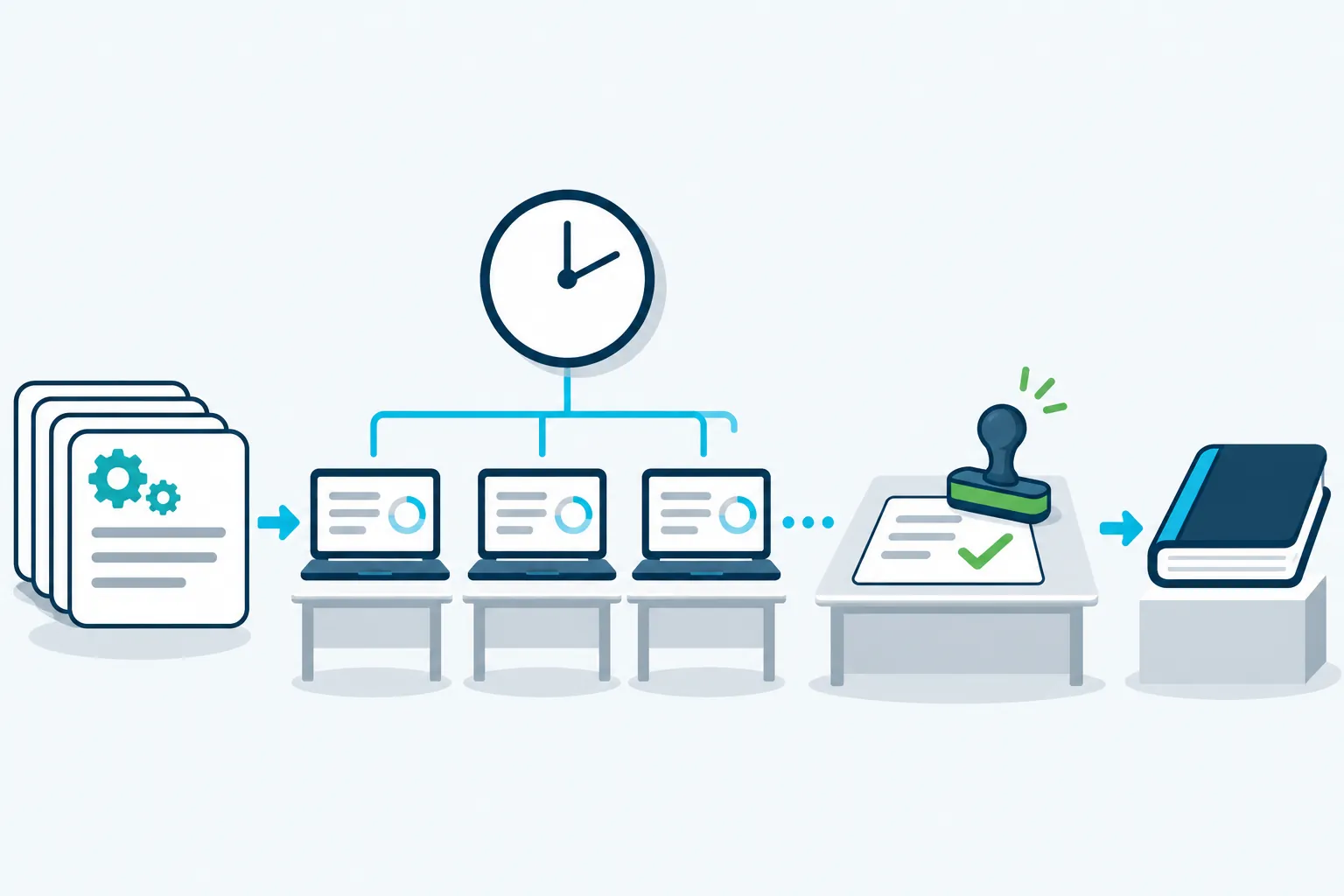
Ramp Stack is Ramp’s AI operating system for accounting teams, launched on June 3, 2026. Agents that Ramp calls Coworkers run reconciliations, schedules, journal entries and monthly reporting from procedures your firm writes once, and Ramp says nothing syncs to the client’s ledger without an accountant’s approval. Stack connects to QuickBooks, NetSuite and Sage Intacct. Ramp prices it per client for accounting firms but doesn’t publish the amount.
Ramp, best known for corporate cards and spend management, built Stack with a first cohort of more than 20 design partner firms. Below: how Stack works, what your reviewers see and still own, which ledgers and clients it covers, pricing, where it may fall short, and how it compares with Basis, Meridian and other alternatives. Our service, Bookkeeper.chat, is a different model and is covered near the end.
Ramp Stack in one table
As described by Ramp on its site, in its blog and at launch, checked November 15, 2026:
| Ramp Stack | |
|---|---|
| Made by | Ramp, a New York fintech company founded in 2019 |
| Built for | Accounting firms that work on many clients, and in-house finance teams |
| Launched | June 3, 2026; built with a first cohort of more than 20 design partner firms |
| How it works | Skills (your written procedures), Coworkers (agents that run them) and routines (schedules) |
| Before anything syncs | Accountant approval; each session leaves an exportable audit log |
| Across clients | Advisor Console for the portfolio; Client Portal for document requests |
| Ledgers named | QuickBooks, NetSuite, Sage Intacct, spreadsheets “and more”; Xero not named |
| Clients on Ramp | Not required |
| Security | Designed with SOC 2 controls; encryption in transit and at rest; no training on your data |
| Price | Per client for accounting firms; amount not published; free trial |
Skills, Coworkers and routines
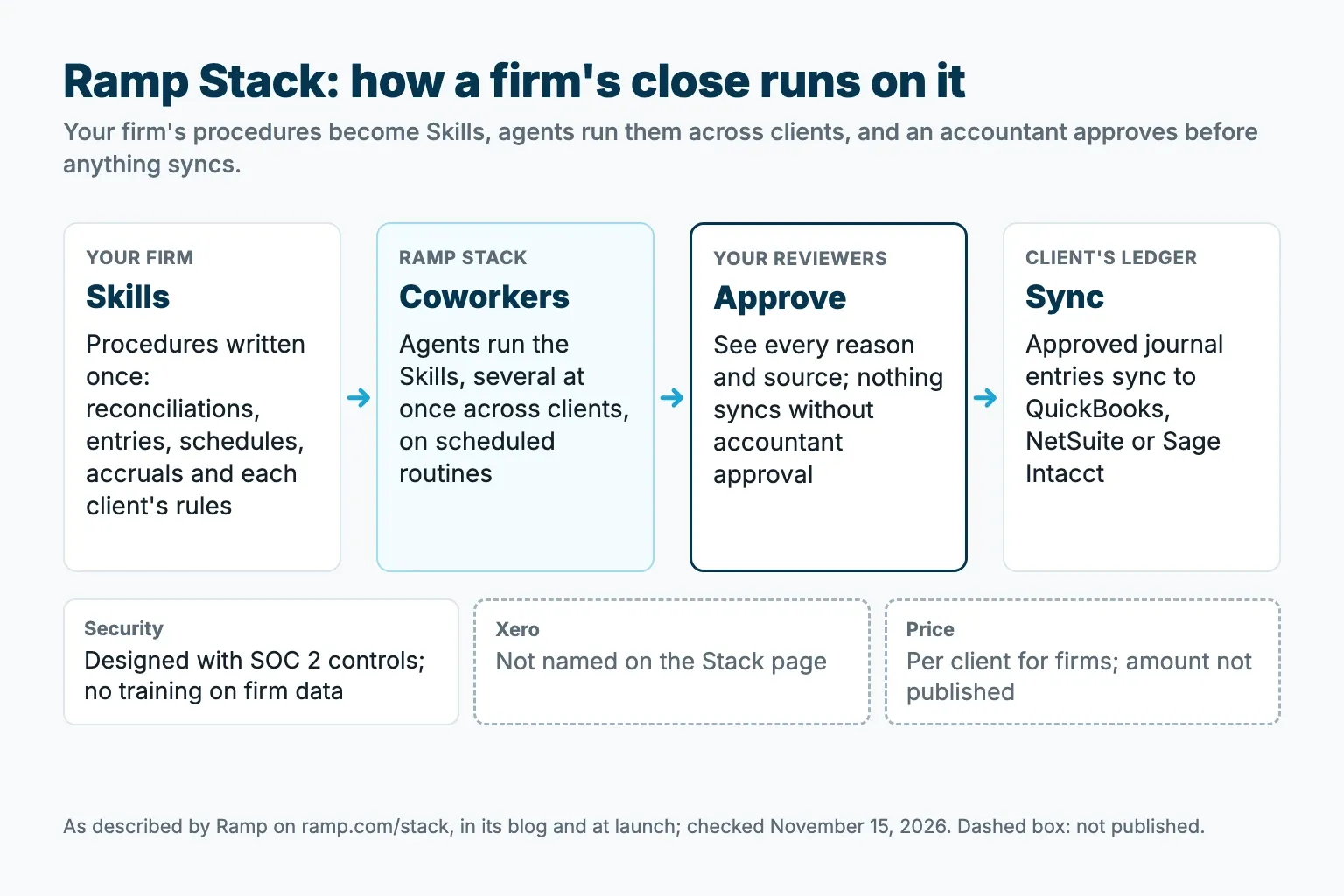
Ramp Stack is organized around three ideas from Ramp’s launch post. Skills are codified procedures: Stack comes preloaded with Skills for reconciliations, journal entries, variance analysis, schedules and accruals, and it learns each client’s rules, such as deferred revenue recognition or project-based spending, once and then applies them every time. Coworkers are the agents that execute those Skills, and several can run at the same time across different clients. Routines put recurring work, such as a monthly reconciliation, on a schedule.
Instructions are written in plain language. According to CFOtech’s launch report, the agents already know concepts such as capitalization rules, revenue timing and depreciation schedules; your firm describes its own processes and each client’s requirements, and the agents confirm the instructions and ask follow-up questions when a process is unclear. Ramp says a firm can connect its systems, upload its close checklists and give agents their first task within an hour. Tasks on each client’s checklist go to staff or to agents, with reviewers and approvers tagged, and the agents build formula-backed workbooks so a reviewer can follow how each figure was calculated.
What your reviewers see before anything posts
The Stack page says you can watch the agents’ work in real time, “every reason, every source, every step”, set guardrails, step in when needed, and “approve what needs judgment before it posts”. Ramp’s October 7, 2026 comparison of Double, Truewind and Stack puts it more strictly: “nothing syncs to the accounting system without accountant approval”. Each session produces a Session Audit Log your team can review and export, and every synced journal entry carries its supporting workbook and links back to the session that produced it. CFOtech’s launch report adds that firms decide which work runs automatically and where human review is required, so check how those settings apply to posting for each client.
Ramp’s launch post says this design came from its design partners. Firms told Ramp they wanted their existing teams to handle more rather than replace people, and that they needed to see an agent’s reasoning before trusting its output, which is why Stack builds formula-based workpapers.
What stays with your reviewers
Beancount, which sells ledger software to small businesses, argues in its August 2026 guide to Stack that the agents draft and the firm still judges. Three areas stand out for a CPA firm:
- Estimates and accruals, such as a bad-debt reserve or a revenue recognition adjustment, depend on facts about the client that the ledger doesn’t hold.
- Nonstandard transactions, such as related-party transfers, owner draws versus distributions, or debt versus equity, turn on agreements and minutes the agent may never see.
- For attest clients, Beancount says independence needs careful scoping when the same AI prepares and reviews the books, and the workpapers must show who reviewed what, when and what changed. It adds that Stack’s audit trail is designed for that record, but only if the firm enforces the review.
Beancount’s summary is to treat Stack as a first-year associate who drafts quickly and needs diligent review.
Which ledgers and clients Ramp Stack covers
The Stack page says agents can “push, pull, read, and write” across QuickBooks, NetSuite, Sage Intacct, spreadsheets “and more”. It doesn’t say which QuickBooks edition, and Xero is not named. Ramp’s October comparisons add that Stack connects to more than 20 other systems, including outside bank and card activity through Plaid, payroll systems such as Deel and ADP, and Google Drive.
Your clients don’t have to use Ramp. CFOtech reported at launch that firms can add clients whether or not they already use it, with integrations for accounting systems, file storage, and outside bank accounts and cards. For clients who already run their cards, bill pay or banking on Ramp, the launch post notes that their spend data is already on Ramp, with no import step.
Advisor Console and Client Portal
Two parts of Stack sit around the agents’ work. The Advisor Console brings projects, tasks, chats and checklists together across every client; CFOtech reported at launch that it shows which tasks are complete, in progress or waiting for approval, and holds the firm’s library of Skills. The Client Portal lets your firm request documents and information from a client through a secure link, and the client doesn’t need a Ramp account. Both are described in Ramp’s October 9, 2026 comparison of Karbon, Truewind and Stack.
Security and your firm’s know-how
Ramp says Stack runs on its infrastructure “designed with SOC 2 controls”, with data encrypted in transit and at rest. The Skills and workflows your firm builds are visible only to your firm, not to clients, other firms or AI labs. Client data is never used to train the models Stack runs on, and Ramp’s contracts with its model providers include zero data retention.
Ramp Stack pricing
Ramp doesn’t publish a price for Stack. Its October 1, 2026 comparison of Double, Karbon and Stack gives the model: per-client pricing for accounting firms, and an annual platform fee with unlimited seats for in-house finance teams. The same table says a free trial is available, the form at the top of the Stack page is headed “Try Stack for free”, and the Stack FAQ says getting started begins with a conversation with a Ramp team member.
Beancount raises two cost points that the Ramp pages we read don’t address. It writes that Stack consumes AI tokens the firm pays for, so ask whether model usage is inside the per-client price or billed on top. It also writes that Ramp deploys Stack with forward deployed engineers who work inside the firm to put its chart of accounts, close calendar and approval policies into context before the agents run. Ramp’s own page talks about a first task within an hour, so ask what onboarding looks like for a firm your size.
What firms say about Ramp Stack
Most public opinion comes from firms Ramp quotes and from early reactions online:
- John Ikosipentarhos, president of Zeroed-In Consulting, quoted on the Stack page: “We’re running multiple agents simultaneously — spending time reviewing work, not doing and then reviewing.”
- Tyler Otto of Specialized Accounting, a 15-person firm in Ramp’s design partner program, said in Ramp’s launch release, as reported by CFO Dive, that Stack is eliminating or reducing month-end close time by 50% for some clients.
- In r/AccountingDepartment, the top reply to a thread asking for thoughts on Stack, shortly after launch, included: “I’m skeptical. Jaded from QBO’s dreadful AI.”
Ramp’s comparisons add its own outcome figures: teams on Stack have seen “up to 60% faster closes and up to 9x faster recurring schedules and reconciliations”. Ramp also says more than 4,500 accounting firms, including 92 of the top 100 CPA firms, partner with Ramp. Ramp gave the same figure on launch day as the number of accounting firms it works with, so it counts Ramp’s partner firms rather than Stack users; the pages we read give no count of firms on Stack.
Ramp also publishes a benchmark of its own product. On 172 tasks (160 from Mercor’s Apex Accounting set and 12 custom Excel and reconciliation tasks), it says Stack met on average 10.1 percentage points more of the evaluation criteria than Claude Code running Opus 5, and 31.7 points more than Codex running GPT-5.6 Sol. In CFOtech’s launch report, Ramp described its benchmark as more than 200 tasks built and graded by working accountants.
Where Ramp Stack may fall short
Double, which competes with Stack, published a list of Ramp Stack alternatives in July 2026 arguing that Stack falls short for firms running many client closes at once. Its points about a missing client portal and single-entity views no longer match Ramp’s October pages (see the last point below). Our own checks as of November 15, 2026:
- Xero isn’t named among Stack’s ledgers. If many of your clients are on Xero, check this first.
- The price is per client, but the amount isn’t published, so you can’t compare cost per client before a call.
- Stack launched in June 2026, and most published opinion so far comes from Ramp, the firms it quotes and its competitors.
- The data advantage applies to clients already on Ramp. Other clients’ bank and card activity comes in through Plaid, according to Ramp’s October comparisons, and Double says that takes more setup.
- Double wrote that Stack has no client portal and only single-entity views. Ramp’s October posts describe a Client Portal and an Advisor Console across clients, so ask to see both in a demo.
Ramp Stack vs Basis vs Meridian
All three sell AI that does close work for accounting firms, with your accountants reviewing. As listed on each vendor’s site on November 15, 2026:
| Ramp Stack | Basis | Meridian | |
|---|---|---|---|
| Made by | Ramp | Basis, founded in 2023 | Pilot |
| Scope | Close work for firms and in-house teams: reconciliations, schedules, entries, reporting | CAS, tax, audit and corporate accounting | Month-end close and recurring CAS work, plus tax prep and FP&A support |
| How the work runs | Coworkers run your firm’s Skills on routines | Agents run each client’s close with your firm’s policies, templates and review standards | Meridian runs the close; your accountants review finished books |
| Before posting | Nothing syncs without accountant approval, per Ramp | Confident coding is pushed; drafted entries wait for review | Routine postings aren’t pre-approved one by one; your firm approves the finished books before client delivery |
| Ledgers | QuickBooks, NetSuite, Sage Intacct | Xero confirmed; QuickBooks reported in 2024 | QuickBooks Online, Xero; NetSuite, Sage Intacct and QuickBooks Desktop in development |
| Security listed | Designed with SOC 2 controls | SOC 2 Type II, ISO 27001, ISO 42001 | Encryption and role-based access; no certification listed on its security page |
| Price | Per client for firms; amount not published; free trial | Not published | Starter free for one user; full plan an annual license per client |
Stack fits a firm that wants to write its own procedures and run them across many clients, especially on NetSuite or Sage Intacct. Basis covers tax and audit as well as CAS. Meridian runs the close for you on QuickBooks Online and Xero. For more on each, see our guides to Basis AI accounting and Meridian vs Botkeeper.
Other Ramp Stack alternatives
Double’s list and Ramp’s own comparisons put a few more names in front of firms; we add our own service last. As listed on November 15, 2026:
- Double: close and practice management for firms, with a client portal and two-way sync with QuickBooks Online and Xero. It lists $10, $25 or $50 per client a month, and its Autoclose add-on, which hands close work to AI agents, costs $500 a month per firm. Double wrote the alternatives list mentioned above, and we cover Double’s tiers and Autoclose in a separate guide.
- Truewind: AI agents that prepare journal entries and reconciliations for review. It lists QuickBooks Online, Sage Intacct, Intuit Enterprise Suite and NetSuite and doesn’t show a price.
- Bookkeeper.chat: a service that closes each client’s month for your firm, priced per client’s monthly close. Details below.
Karbon, Financial Cents and Canopy also appear in these lists, described there as practice management tools for workflow and client requests rather than close execution. Ramp notes that Karbon is rolling out a Close Automation feature.
Questions to put to Ramp
- Which QuickBooks edition does Stack support, and is Xero on the roadmap?
- Which work can run without review, and can we require approval per client before anything syncs?
- What does Stack cost per client at our client count, and what does the free trial cover?
- Are AI model costs included in that price?
- Who sets Stack up for our firm, and how long does onboarding take?
- If we leave, can we export our Skills, workpapers and session logs?
Run one closed month through it
To judge Stack on your own work, give it a month your firm has already signed. Pick two or three clients, load the same statements into a copy of each file, and let the Coworkers run your Skills. Then compare each account with your final books and count what your senior would have changed. Our closed-month test guide has the scoring sheet.
Where Bookkeeper.chat is different
Bookkeeper.chat publishes this guide and sells a related service. Ramp’s launch post draws the line itself: it contrasts Stack, which gives firms “the architecture to build their own operation”, with products that do the accounting for firms. Bookkeeper.chat is the second kind. It does each client’s month for you: an AI Bookkeeper prepares it and emails your client the questions, an AI Reviewer checks every entry, and your senior signs off.
| Ramp Stack | Bookkeeper.chat | |
|---|---|---|
| What you buy | A platform your staff runs with its own Skills | Each client’s monthly close, as a service |
| Who does the work | Your staff directs Coworkers | An AI Bookkeeper; your senior makes the judgment calls |
| Questions to your client | Your firm requests documents through the Client Portal | The AI Bookkeeper emails them; your client needs no registration or new app |
| Review | Your staff reviews each session’s work and audit log | An AI Reviewer checks every entry and records why; your senior approves the close |
| When the ledger changes | After accountant approval, through sync | QuickBooks Online or Xero updates only after your senior explicitly approves |
| Price | Per client for firms; amount not published | Per client’s monthly close, quoted after a call |
The fit is a firm that wants to add clients without piling more review on its senior. For a first test, pick a client whose month runs through bank, card and Stripe accounts and whose balance sheet is straightforward. The guarantee rests on coverage: the share of a month’s entries the AI team prepared and checked with no senior corrections, with entries completed from your client’s email replies counted in. When a client-month’s coverage is below 92%, that client-month is free.
Run the same comparison on one client’s closed month with us, for free: Request a Closed-Books Test.
FAQ
What is Ramp Stack?
Ramp Stack is Ramp’s AI operating system for accounting firms and in-house finance teams, launched on June 3, 2026. Firms write procedures as Skills, agents called Coworkers run them on a schedule across clients, and an accountant approves the work before journal entries sync to QuickBooks, NetSuite or Sage Intacct.
How much does Ramp Stack cost?
Ramp doesn’t publish a price for Stack. Its October 2026 comparison says accounting firms pay per client and in-house finance teams pay an annual platform fee with unlimited seats, and that a free trial is available. Getting started begins with a conversation with a Ramp team member, so ask for the per-client price at your client count and whether AI model costs are included.
Does Ramp Stack work with QuickBooks Online and Xero?
Ramp’s Stack page lists QuickBooks, NetSuite, Sage Intacct and spreadsheets but doesn’t say which QuickBooks edition. QuickBooks, NetSuite and Sage Intacct are the three ledgers Ramp names there. Xero is not named on that page, so a firm with Xero clients should confirm support with Ramp before a trial.
Do clients need to use Ramp to use Ramp Stack?
No. Ramp said at launch, as reported by CFOtech, that firms can add clients to Stack whether or not those clients use Ramp, with integrations for accounting systems, file storage and outside bank accounts and cards. Clients who already use Ramp’s cards, bill pay or banking have their spend data on Ramp, so Stack can work with it without an import step.
Does Ramp Stack post entries without approval?
Ramp says it doesn’t. Its October 2026 comparison states that nothing syncs to the accounting system without accountant approval, and each session produces an exportable audit log. The Stack page also describes guardrails and approving what needs judgment before it posts, and CFOtech reported at launch that firms choose which work runs automatically, so confirm the approval settings for each client in a demo.
What are Skills and Coworkers in Ramp Stack?
Skills are procedures written once and reused, such as how your firm reconciles a credit card or books deferred revenue for a client. Coworkers are the AI agents that execute Skills, several at a time. Routines schedule recurring work so it starts on its own. Stack ships with Skills for reconciliations, journal entries, variance analysis, schedules and accruals.
Is client data safe in Ramp Stack?
Ramp says Stack runs on infrastructure designed with SOC 2 controls and encrypts data in transit and at rest. A firm’s Skills and workflows stay private to that firm, client data isn’t used to train the models, and Ramp’s agreements with its model providers include zero data retention.
What is the difference between Ramp Stack and Basis?
Ramp Stack is a platform where a firm writes its own procedures and AI coworkers run them, with connections to QuickBooks, NetSuite and Sage Intacct. Basis offers AI agents across client accounting, tax and audit, with Xero confirmed on its app listing, no published prices and access by demo or waitlist. Both leave judgment calls with the firm’s accountants; Basis pushes high-confidence coding automatically and stages drafted entries for review.
How is Bookkeeper.chat different from Ramp Stack?
With Ramp Stack, an accounting firm’s staff writes Skills and directs the AI coworkers that run them. Bookkeeper.chat is a service: it closes each client’s month for the firm and charges per client’s monthly close. Its AI Bookkeeper prepares the month and emails the client its questions, an AI Reviewer checks every entry, and nothing changes in QuickBooks Online or Xero until the firm’s senior approves the close.
Sources
- Ramp, AI Platform for Accounting Teams | Ramp Stack, checked November 15, 2026.
- Ramp, Ramp Stack: Built in the room where the work actually happens, June 3, 2026.
- Ramp, Double vs Karbon vs Ramp Stack: Which Platform Is the Right Choice?, October 1, 2026.
- Ramp, Double vs Truewind vs Ramp Stack: Which AI Accounting Platform to Choose?, October 7, 2026.
- Ramp, Karbon vs Truewind vs Ramp Stack: A Full Comparison, October 9, 2026.
- CFO Dive, Ramp rolls out accounting, close-focused AI operating system, June 3, 2026.
- CFOtech, Ramp launches AI-native Stack for accountants at firms, June 4, 2026.
- Double, Compare Top Ramp Stack Alternatives July 2026, July 27, 2026.
- Beancount, Ramp Stack and the Rise of the “AI Operating System” for Accounting, August 13, 2026.
- Reddit, r/AccountingDepartment, “Thoughts on Ramp’s new Ramp Stack Tool?”, posted about five months before November 15, 2026, read through Google search results on November 15, 2026.
- Basis, AI Agents for Accounting, checked November 15, 2026.
- Basis, Basis for CAS & Advisory, checked November 15, 2026.
- Basis, Basis for Small Firms, checked November 15, 2026.
- Basis, Security, checked November 15, 2026.
- Xero App Store, Basis App, checked November 15, 2026.
- Accounting Today (Bloomberg), AI-for-accounting startup Basis hits $1.15B valuation, February 24, 2026.
- Maginative, Basis Secures $34M to Deploy AI Agents for Accounting Firms, December 17, 2024.
- Meridian, The AI operating system for accounting firms, checked November 15, 2026.
- Meridian, Pricing, checked November 15, 2026.
- Meridian, AI Info, last reviewed November 13, 2026.
- Meridian, FAQ, checked November 15, 2026.
- Meridian, Security, checked November 15, 2026.
- Double, Pricing & plans, checked November 15, 2026.
- Truewind, AI Accounting Agents for Sage Intacct & QBO, checked November 15, 2026.
- Truewind, Pricing, checked November 15, 2026.